


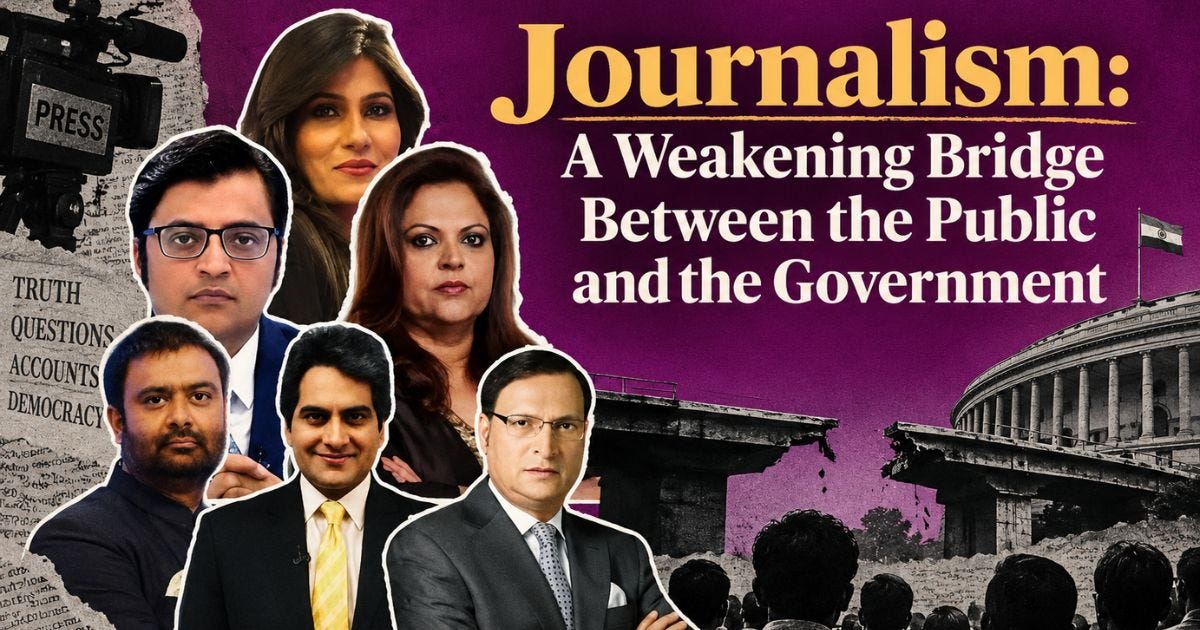
“I still believe that if you aim to change the world, journalism is a more effective and immediately useful weapon.” — Tom Stoppard.
In any democratic country, journalism is one of its important pillars. Journalism is a reliable way for the public and the government to exchange information. It is a medium that gives everyone an equal opportunity to express their views and present their problems before the people with honesty, impartiality, and respect.
But what happens when this bridge between the public and the government weakens, or when it sits in the lap of power and authority and, instead of discussing public issues and presenting the public’s side, becomes the mouthpiece of a particular party and system?
The condition of the Indian media, whether print, digital, or television, is extremely serious in all three forms. There are many examples to discuss when it comes to the media, but today I want to describe some important recent incidents to you.
The first incident is related to the News Broadcasting and Digital Standards Authority of India (NBDSA). According to it, in a case related to a protest connected with Aligarh Muslim University, news was presented in a misleading manner, and the actual issue of the protest was pushed into the background.
The matter was related to the statements and slogans of Talha Mannan, a student and student leader of Aligarh University, during the student movement against the increase in fees at Aligarh Muslim University. Talha Mannan had reached there to support the students’ movement. He delivered a speech of around 20 minutes and raised slogans. After this, the university administration accepted the students’ demands and brought the protest to an end.
In such a situation, it was the responsibility of the media to take the matter seriously and provide impartial media coverage. But how could Zee News stay behind when it came to the changing attitude of the media?
Four days after the speech, it aired a video of the slogan without providing any context. As a result, the matter reached the NBDSA, and according to media reports, the NBDSA found in its investigation that Zee News had failed to show the actual reason for the protest—the increase in tuition fees—and instead focused its coverage on a short slogan that had been raised out of context, thereby presenting the matter incorrectly.
The slogan made it appear as though the protest was about the Israel-Gaza war. The regulator also said that the channel’s on-air language, which included a reference to giving the protesters “Yogi-style treatment,” was provocative and was more likely to incite action against the students rather than simply present the news.
Another incident has recently come from Madhya Pradesh, where a tragic incident took place in the Banda area of Sagar district, in which several people fell ill and subsequently died after consuming poisonous liquor. Sixteen people lost their lives in this incident, and so far 19 accused have been arrested in the case.
To meet the victims of this incident, Abhijit Deepak, the founder of the Cockroach Janata Party, had travelled to Madhya Pradesh, where, allegedly, some media persons who had come from outside asked him provocative questions.
Following this, Abhijit Deepak issued a humorous statement on his social media account saying that he would resign from the post of Chief Minister of Madhya Pradesh. The working style of the media and its manner of questioning in the entire matter came under strong criticism.
Local media persons alleged that these supposed media persons had been brought from outside and sponsored so that politics could be played around the incident and people’s attention could be diverted from the real issues of the public.
If the entire matter is examined seriously, the media’s responsibility was to question the government about its responsibility for the deaths and to talk about helping the victims. But the alleged outside media persons surrounded Abhijit Deepak and bombarded him with questions such as, “How long will you do politics over dead bodies?”
This clearly shows that, in the name of journalism, these people reached the spot merely as mouthpieces of a particular party and, instead of questioning the government, began asking unnecessary questions to another individual.
The third case concerns The Hindu, a major institution in print media and an organisation that claims to be India’s most prominent newspaper. The matter was that The Hindu faced strong criticism over a full-page advertisement and subsequently issued an “apology.” The advertisement portrayed Gurmeet Ram Rahim Singh, the convicted rapist and chief of Dera Sacha Sauda, positively.
The advertisement, titled “What is Dera Sacha Sauda? (Facts vs Fiction)”, was published on the front page of the Delhi, Mohali and North India editions of the newspaper. It emphasised the social work of Dera and presented several figures related to the organisation without any independent verification or source.
In the apology issued on Sunday, 13 September, The Hindu said that it was “deeply sorry” for publishing the advertisement. The newspaper said that the advertisement contained several claims, including the claim that a conspiracy had been hatched against Ram Rahim by “drug mafias and anti-Dera forces.”
If such a large institution, with such a vast system, cannot verify the truthfulness of an advertisement, then how will it be able to win the trust of the public?
In the game of money and advertising, such incidents are not merely mistakes but are deliberately carried out to make money. Since the matter was serious and criticism from people was increasing, the institution apologised. Otherwise, how many such news reports and advertisements may be misleading us, making someone a star in one place and making fools of us somewhere else?
At a time when it is becoming difficult to distinguish between a media report and an advertisement, such incidents of mistakes and negligence create many concerns.
Finally, the condition of the Indian media is already declining, and such continuous incidents are making the situation worse instead of bringing any improvement.
I am reminded of the words of senior Indian journalist Ravish Kumar, who has said that there was never really a golden age for the Indian media, but the condition of the media today appears even more unfortunate.
What is needed is for students of media to understand the finer aspects of media and to carry forward the work of journalism with honesty, impartiality and responsibility, so that, in the words of Tom Stoppard, the path towards changing the world and bringing about revolution can become easier.
Disclaimer: This article is written by Mohammad Swaleh Ansari. The views expressed are solely those of the author and do not necessarily reflect those of Non Aligned Gazette. The article has been reviewed by our editorial team.