



United States of America is celebrating 250 years of freedom across the world, particularly India (where Trump Avenue has recently been in the news), but as much as it is celebrating freedom, the so-called “world power” is taking away the freedom and basic human rights of the civilians especially in Asia by bombing or taking freedom from them to make decisions for their own country, and actually this is not the first time the US is doing so, it has a track record of 250 years of oppression, destruction and war crime. There are some of the major events which expose the US’s dirty politics for power and capitalistic desires.
The “Freedom” Philosophy
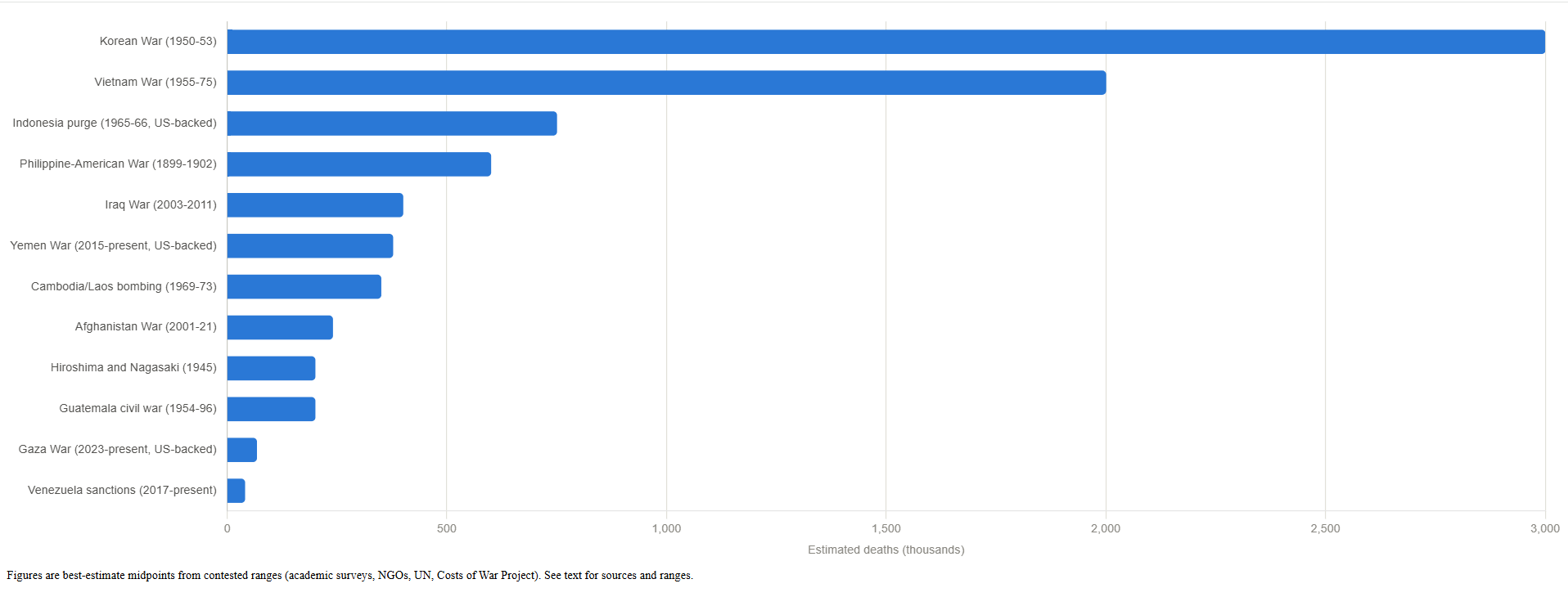
The United States has a very old story of destroying a nation, intervening in its government in the name of freedom and human rights. After the US took the Philippines from Spain in 1899, it turned its guns on the very people and claimed that it was freeing. The fighting that followed killed some 200,000 to a million Filipinos, most of them were ordinary men and women caught in war, hunger and disease. It was one of the first times that the world witnessed a pattern that would repeat itself repeatedly. Freedom to America and blood paid for by someone else.
Biggest war crime of human history
The biggest war crime in human history is also done by America. In 1945, the United States dropped atomic bombs on Hiroshima and Nagasaki in Japan. Between 150,000 and 246,000 people died, many of them in days; some slowly over the years from radiation sickness. These were not soldiers on a battlefield. They were families, schoolchildren, shopkeepers, and people living their ordinary lives when the sky opened up.
Korea, and a war that never really ended
The Korean War in the early 1950s brought millions of people— no link to politics at all— into millions of people who had nothing to do with the politics behind it. Around three million people died on both sides, most of them Korean civilians. And even today, the two Koreas remain divided, a wound that America started and never entirely closed.
Toppling governments in Guatemala, Chile, and beyond
American soldiers did not always send its own troops. Sometimes it did, however, just help remove a government it did not like. In 1954 in Guatemala, a democratic government was overthrown by American power with American support, and civil war ensued in Guatemala that killed more than 200,000 people. In Chile in 1973 US support brought General Pinochet to power; his government killed thousands and tortured many more. These were not accidents. They were choices, made because Washington did not like the direction these countries were choosing for themselves.
Indonesia’s silent tragedy
Between 1965 and 1966, Indonesia went through one of the deadliest anti-communist purges in modern history. The United States gave intelligence and support to the people carrying it out. Somewhere between 500,000 and a million people were killed. Most of the world barely talks about it, but the numbers tell their own story.
Vietnam, Laos, and Cambodia, a war that spilled across borders
The Vietnam War is one of the most well-known American wars, and for good reason. Somewhere between 1.5 million and nearly 4 million Vietnamese people died. But America did not stop at Vietnam’s borders. It conducted secret bombing campaigns in Laos and Cambodia, killing hundreds of thousands more and fueling the chaos that allowed the Khmer Rouge to later execute genocide in Cambodia.
Central America in the 1980s
In Nicaragua and El Salvador, American money and weapons fueled civil wars that killed tens of thousands of people. The toll in Nicaragua was about 30,000. In El Salvador it was about 75,000. These wars were fought in the name of stopping communism, but the people who paid the price were farmers, teachers and children who had no say in any of it.
Iraq, sanctions, and two wars
West Asia has been one of the favorite war grounds for the US. Iraq has felt America’s hand more than almost any other country in the world. The Gulf War in 1991 killed at least 100,000 to 200,000 Iraqis (and at least some of them were mostly ordinary people in the long run), the months of sanctions that followed inflicted a severe blow to the lives of the poorest people in Iraq, cutting off medicine and food in ways which are still debated and that were undeniably cruel. Then came the invasion in 2003, and the war and occupation that killed anywhere from 150,000 to over 450,000 people across the years (with great uncertainty), a war and occupation to date that has been estimated to have killed 150,000 to over 450,000 people, the estimates are still in dispute. A country was torn apart in the name of weapons that were never found.
Afghanistan, the twenty-year war
After the attacks on 9/11, America invaded Afghanistan and stayed for twenty years. By the time it left in 2021, tens of thousands of Afghan civilians had died, along with security forces, aid workers, and journalists. Brown University’s Costs of War project puts the direct death toll from America’s post 9/11 wars, in Iraq, Afghanistan, Syria, Yemen, and Pakistan at more than 940,000 people, with millions more indirectly killed by the destruction of hospitals, water systems and economies.
Yemen and Gaza, the newer chapters
And America’s fingerprints are not only on history. In Yemen, American weapons and support for a Saudi-led coalition have been part of a war that the United Nations believes has killed around 150,000 people directly, with hundreds of thousands more dying from hunger and collapsed healthcare. In Gaza, American military and political support for Israel’s campaign has coincided with a death toll Gaza’s health ministry puts at more than 67,000 people as of late 2025.
Venezuela, a different kind of war
Not every American weapon is a bomb. Years of American sanctions have so squeezed Venezuela’s economy that some economists say tens of thousands of people have died as an indirect result, from lost oil income to shortages of medicine. No missiles were fired, but the impact on ordinary lives was still severe.
The America’s story
To be fair, America has never framed any of this as an oppression. Each war had its own official reason. Ending communism, defending allies, fighting terrorism, removing dictators, and defending human rights. And many Americans and their allies believed, and still believe, to be true, that these were the necessary things to do in a dangerous world. Historians and governments are still debating how much of this was an act of self-defense and how much was overreached.
A pattern worth remembering
The numbers tell a story, and they tell a story no matter what reasons are put forward. Millions of people in Asia, Latin America, and beyond have paid for their lives, their homes and their right to choose for themselves to make a future. And as America celebrates 250 years of its own freedom, it is not hard to ask one simple question. Freedom for whom, and at what cost to everyone else?